




















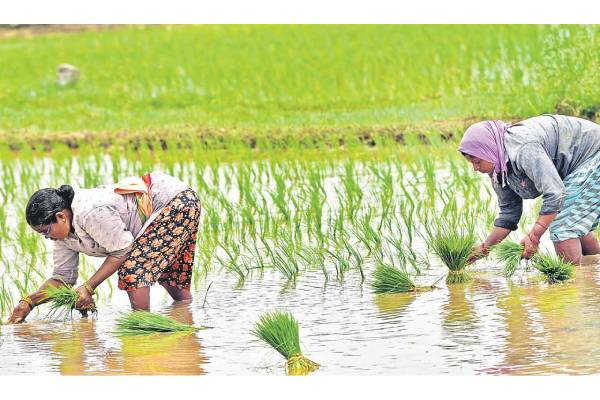
A major political debate has erupted in Telangana over paddy cultivation, but the controversy is rooted in a problem that has been building for years.
Over the last two-and-a-half years, the state government has spent close to ₹16,000 crore procuring paddy beyond the quantities mandated by the Centre. The objective was straightforward: prevent farmers from suffering losses when market demand and procurement capacity failed to match production.
The current Congress government, led by Chief Minister Revanth Reddy, is now urging farmers to reduce dependence on water-intensive paddy cultivation and consider alternative crops. The opposition BRS has attacked this position, portraying it as anti-farmer. However, the debate has revived memories of a remarkably similar stand taken by the previous BRS government itself.
During 2021-22, then Chief Minister K. Chandrashekar Rao repeatedly cautioned farmers against excessive paddy cultivation. His administration argued that continuing to expand paddy acreage was becoming economically and practically unsustainable.
Several factors drove that policy:
• The Centre and the Food Corporation of India were unwilling to procure parboiled rice from Telangana.
• Record production had created large surpluses, leading to storage and marketing challenges.
• Farmers were encouraged to shift toward crops such as cotton, red gram, groundnut and chilli, which offered stronger market opportunities.
The circumstances confronting the state today are not fundamentally different. Telangana is dealing with concerns over rainfall and water availability linked to adverse weather conditions. Since paddy requires substantial irrigation, the government is advising farmers to diversify into less water-dependent crops to reduce risk and improve returns.
Despite having advocated a similar strategy while in power, the BRS has now adopted the opposite position. Its campaign demanding procurement of all paddy produced by farmers stands in sharp contrast to its earlier warnings about overproduction and unsold stocks.
At the same time, the government has attempted to influence cropping patterns through incentives. A bonus was announced for fine rice varieties with the aim of encouraging cultivation of higher-value grain that could be supplied through the public distribution system.
However, farmer preferences have remained largely unchanged. Coarse rice continues to dominate because it matures quickly, delivers higher yields and is relatively resilient. As a result, of the nearly 70 lakh tonnes of rice procured this season, about 56.5 lakh tonnes consists of coarse varieties.
This has left the state with a difficult challenge. Large quantities of coarse rice are accumulating even as market demand remains limited. The government continues to bear the financial burden of procurement, storage and management of surplus stocks.
The larger issue, therefore, is not simply about paddy cultivation. It is about balancing farmer welfare, water availability, market demand and the state’s finances. What was once presented as a necessary agricultural adjustment has now become a political flashpoint, with both sides seeking advantage from a problem that has been years in the making.