























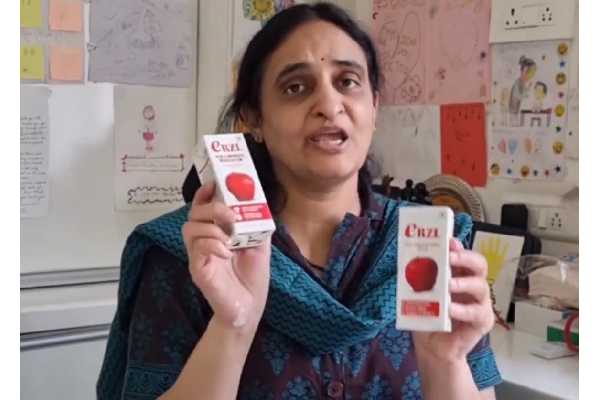
Hyderabad-based paediatrician Dr Sivaranjani Santosh has refused to back down after receiving a legal notice from Johnson & Johnson Pvt. Ltd. and JNTL Consumer Health (India) Pvt. Ltd., a Kenvue group company, over her social media posts on ERZL and ORSL.
Speaking publicly after the notice on Tuesday, Dr Sivaranjani said the issue is much bigger than a brand dispute. According to her, it is about parents being misled, children being given the wrong drink during diarrhoea, and doctors being pressured for speaking up on a public health issue.
At the centre of the controversy is a simple but serious question: When a parent asks for ORS at a pharmacy, are they always getting actual Oral Rehydration Solution?
That is the concern Dr Sivaranjani Santosh says she has been raising for years.
She has alleged that products like ORSL, and now ERZL, have long created confusion because of how closely they resemble ORS, the medically recommended oral rehydration solution used to treat dehydration caused by diarrhoea.
What is the issue?
According to Dr Sivaranjani, the problem is not just what is inside the pack, but how the product is named, packaged, placed and promoted.
She says genuine WHO-recommended ORS is carefully designed to help rehydrate children and adults suffering from diarrhoea. It contains a specific balance of glucose and salts, and has a reduced osmolarity formula meant to prevent dehydration, reduce vomiting and lower the need for IV fluids.
But if a caregiver is instead handed a high-sugar electrolyte drink thinking it is ORS, the result can be dangerous, she argues.
According to Dr Sivaranjani, liquids with very high sugar and osmolarity can actually pull more water into the gut and make diarrhoea worse instead of treating it. She has claimed that the earlier ORSL formula had a much higher sugar content and osmolarity than medically recommended ORS.
Why is she raising this now?
The matter has intensified after Johnson & Johnson and Kenvue sent Dr Sivaranjani Santosh a legal notice on March 16, 2026, asking her to take down her posts and reels about ERZL and ORSL.
The notice allegedly demanded that she remove all such content within seven days, submit details of what was removed, and avoid making similar posts in future. It also accused her of making false and unscientific claims, spreading misinformation, damaging the companies’ brands and acting for commercial gain.
Dr Sivaranjani Santosh has rejected those allegations outright.
She says her criticism is based on child health, consumer confusion, and years of public advocacy, not defamation or personal gain. She has also called the allegation that she is doing this for “views” or “commercial interest” outrageous.
How did ORSL become ERZL?
The controversy has roots going back years.
According to Dr Sivaranjani Santosh, the product originally entered the market in 2003 as “ORS-L”, before later becoming ORSL. She says the confusion deepened after the branding changed and the product became more aggressively marketed in pharmacies and hospitals.
The issue then took a regulatory turn in October 2025, when the Food Safety and Standards Authority of India (FSSAI) issued orders saying no food or beverage product could use the term “ORS” in its label, branding or marketing unless it matched the WHO-recommended formula and had the required CDSCO approval.
After that, JNTL Consumer Health (India) Pvt. Ltd. challenged the order before the Delhi High Court, but the court did not grant a stay. The company later withdrew its petition and rebranded ORSL as ERZL.
But Dr Sivaranjani Santosh says the confusion has not ended.
She argues that ERZL still looks and sounds too similar to ORSL, and that many consumers who previously mistook ORSL for ORS are likely to make the same mistake again. She has even filed a trademark objection, arguing that the new branding remains too close in appearance and recall value.
Her concern: ‘Parents are still being confused’
One of the strongest points made by Dr Sivaranjani Santosh is that this confusion does not play out on paper or in courtrooms alone. It happens at the pharmacy counter.
She says many parents do not know the difference between a medical ORS product and a commercial electrolyte drink, especially when both are sold in similar places and similar-looking packs.
According to her, many simply ask for “ORS” and trust whatever is handed over.
That, she says, is the real danger.
She also alleged that ERZL is being positioned in marketing as the new ORSL, which in her view keeps alive the very same public confusion that regulators had tried to address.
What about sucralose?
Another major issue raised by Dr Sivaranjani Santosh is sucralose, the artificial sweetener used in ERZL.
She says this has become a key point of debate because electrolyte drinks are now being marketed for regular hydration, including for children.
According to her, this is not medically appropriate.
She cited the World Health Organization’s 2023 guideline on non-sugar sweeteners, saying it raises concerns about the long-term use of such ingredients and their possible links to gut inflammation, metabolic issues and insulin resistance.
Her position is not that such drinks can never be consumed, but that they should not be promoted as everyday hydration drinks for children, and should definitely not be confused with ORS used during diarrhoea.
Cases she cited
To explain why she sees this as a serious public health issue, Dr Sivaranjani Santosh cited examples she says were reported to her over the years.
One involved a child in Chennai with diabetes who was repeatedly given ORSL during diarrhoea and later developed diabetic ketoacidosis and coma. Another involved a child in Bengaluru with burns whose dehydration allegedly worsened after being given the wrong product.
She says these are not isolated misunderstandings, but examples of what can happen when branding and real medical use get mixed up.
Her bigger allegation: doctors are being intimidated
Beyond the product debate, Dr Sivaranjani Santosh says the legal notice raises a larger issue: Can doctors openly criticise products that may affect patient safety?
She has said that as a practising paediatrician, she has both a professional duty and a constitutional right to warn parents about products that may be misunderstood in a medical context.
She also said she has faced online trolling, abuse and threatening messages, especially after posting about ORSL and ERZL. According to her, some messages even suggested that “good people will be killed” and questioned how much “insurance” she had.
Despite that, she says she will continue.
What does she want now?
Dr Sivaranjani Santosh has laid out a clear set of demands.
She wants:
->a public apology
->a complete rebranding that does not resemble ORSL
->an end to what she calls misleading marketing
->and stricter government rules to stop electrolyte drinks and lookalike products from being placed alongside ORS in pharmacies.
She has also called for a larger public awareness campaign so that parents know how to identify WHO-recommended ORS, how to prepare it correctly, and when it should actually be used.
Company stand
According to the legal notice, Johnson & Johnson and Kenvue maintain that ERZL is a compliant product, that sucralose is approved by regulators, and that the rebranding process has been completed properly.
The companies have also said they are open to dialogue, provided the posts are taken down.
For now, however, Dr Sivaranjani Santosh has made her position clear:
She is not deleting the posts.