












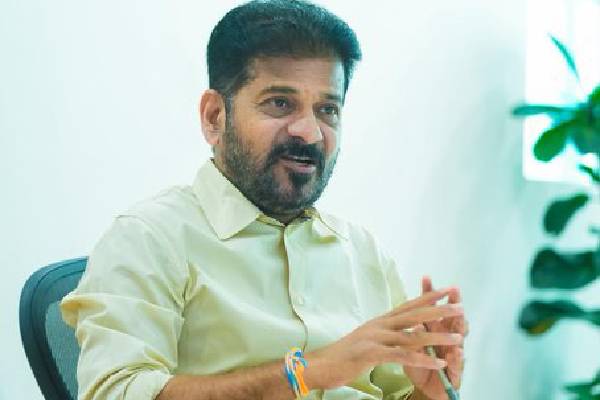
Chief Minister A. Revanth Reddy has directed officials to launch 100 “Telangana Public Schools” this year, one each in 100 Assembly constituencies outside Hyderabad, in a major push to upgrade government education infrastructure.
Reviewing the Education Department at the Command Control Centre, the Chief Minister said the new schools should be developed on the lines of the Telangana Public School at Arutla in Manchal mandal of Rangareddy district, with full-fledged classrooms, playgrounds, qualified teaching staff and dedicated transport facilities.
He made it clear that the government would not hesitate to spend what is necessary to transform government schools into centres of quality education.
Corporate-Style Infrastructure in CURE Region
The Chief Minister instructed engineers to build government schools in the Core Urban Region Economy (CURE) limits on par with corporate institutions. He said the 12 new integrated schools planned in the CURE region must be completed within a year, with facilities comparable to leading institutions such as Bharatiya Vidya Bhavan and Jubilee Hills Public School in Hyderabad.
In addition, 17 schools in the CURE region will be upgraded, while 164 schools will receive additional classrooms and infrastructure. The Chief Minister said there should be no compromise in quality.
As part of the government’s upcoming 99-day programme, one full week will be dedicated to education. Public representatives and officials will visit schools and colleges to assess infrastructure gaps and ensure swift resolution.
AI Training for Teachers, Curriculum Reforms
With Artificial Intelligence reshaping global economies, the Chief Minister directed officials to introduce AI-related teaching from the school level. Short-term training programmes will be organised for teachers and lecturers to help them adapt to emerging technologies.
He said Telangana must prepare its students to seize global opportunities created by AI and called for necessary reforms in the technical education system.
AI-based courses are to be introduced immediately in polytechnics and ATCs. Outdated courses will be phased out. The Chief Minister also directed that students completing polytechnic and technical courses should have direct linkages to industry for employment.
Breakfast Scheme from 2026–27
From the 2026–27 academic year, breakfast will be provided to students in all government schools. The Chief Minister reviewed arrangements with officials and representatives of the Hare Krishna Mission.
Along with breakfast, each student will be given milk, to be sourced from Vijaya Dairy. Technology will be used to monitor calorie intake and ensure nutritional standards.
Students will also receive expanded school kits this year, including school bags, pens, pencils, sharpeners, colour pencils, geometry boxes, dictionaries, shoes and socks. Officials were instructed to allocate the required funds in the Budget.
University Funding and Osmania Allocation
The Chief Minister said funds would be allocated to all state universities. He recalled that ₹1,000 crore has already been sanctioned to Osmania University.
He directed Higher Education Council Chairman Prof. Balakrishna Reddy to submit a report detailing the financial requirements of other universities in the state.
Fee Regulation Panel Proposed
On regulation of private school fees, the Telangana Private School Fee Regulatory Monitoring Commission presented its report. After hearing officials, the Chief Minister proposed a two-tier system.
At the district level, committees led by Collectors and District Education Officers will review school fee structures and submit reports. At the state level, a final committee headed by a retired judge or retired Chief Secretary will take decisions.
A draft framework will also be placed in the public domain to seek feedback from parents, intellectuals and civil society groups.
Education Policy Report Submitted
The Telangana Education Commission, led by Chairman Akunuri Murali, submitted its comprehensive education policy report to the Chief Minister. The Commission said it studied best practices from countries such as the United States, Vietnam and Malaysia, as well as models from other Indian states.
After detailed discussions, the Chief Minister assigned a committee headed by government advisor Dr. Keshava Rao to examine which recommendations require legal backing and which can be implemented from the next academic year.
Senior officials, education advisors and vice-chancellors of state universities were present at the review meeting.