



















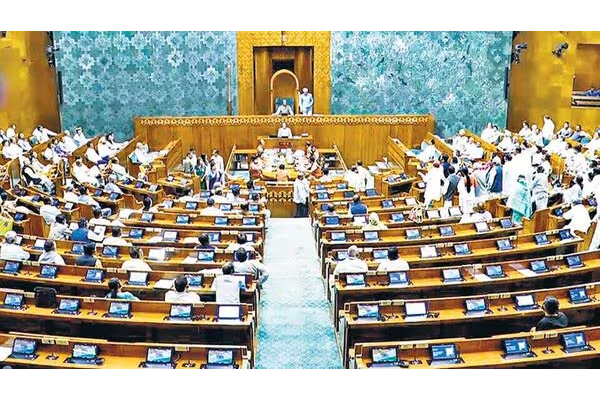
The 150th anniversary of Vande Mataram should have been a moment of national pride. Instead, it turned into a fiery clash in Parliament. The national song that once united freedom fighters has now become a tool in a political tug of war. The ruling NDA brought the issue to the House with full force. The Congress countered with equal intensity. The debate raised one big question. Why is Vande Mataram back in the political battlefield today?
A Debate Meant for Unity Turns Into a Contest for Votes
Congress MP Priyanka Gandhi Vadra questioned the very need for this discussion. She argued that the government revived the topic to benefit from the upcoming Bengal election. According to her, the national song lives in every corner of India. So she felt there was no need to reopen a settled issue. She said Parliament must spend its valuable time on jobs, development and price rise. Not on a cultural debate that has already been resolved by the Constituent Assembly long ago.
PM Modi Fires Back With Historical Charges
Prime Minister Narendra Modi used the moment to attack the Congress on historical grounds. He accused Jawaharlal Nehru of surrendering to the Muslim League in 1937. He said Nehru “accepted Jinnah’s objections” and removed key parts of the song. The Prime Minister argued that this was the beginning of the Congress’ “appeasement mindset” which eventually shaped the politics of Partition.
He reminded the House that nationalists had protested when parts of the hymn were set aside. He said the Congress weakened the cultural foundation of the freedom movement by yielding to pressure.
Priyanka Counters With the ‘Full Chronology’
Priyanka Gandhi presented a long explanation. She said the Prime Minister selectively quoted Nehru. She read out letters exchanged between Nehru, Netaji Subhas Chandra Bose and Rabindranath Tagore. These letters suggested that only the first two stanzas were traditionally sung during the freedom struggle. Tagore himself stated that the rest of the poem could sound communal in the tense atmosphere of the 1930s.
She argued that the Congress Working Committee took a responsible decision. It retained the two stanzas that inspired countless revolutionaries. She asked why leaders like Ambedkar and Shyama Prasad Mukherjee, who were present in the Constituent Assembly, never objected.
Allies Split. BJP Stands Firm. Debate Deepens.
The BJP’s allies reacted differently. The Lok Janshakti Party and the Telugu Desam Party supported the government. They accused the Congress of tampering with the song and upsetting its sacred legacy. JD(U), however, avoided confrontation and focused on the emotional power of Vande Mataram rather than the political battle around it.
This divergence showed how sensitive cultural symbols can be. Even close allies hesitate to take extreme positions.
Why Is Vande Mataram Back in Parliament?
Many political observers believe the ruling coalition wanted to use the moment to reinforce its cultural narrative. The NDA has often pushed themes linked to heritage and nationalism. Raising the song’s history in Parliament strengthens this larger agenda. Yet critics ask a sharper question. How does this debate help ordinary citizens? Vande Mataram is already respected across the country. Reigniting old historical disputes does not solve unemployment or rising prices. It does not answer questions about development or governance.
Why Congress Is Struggling to Defend Its History
Congress fears that every historical debate paints Nehru in a negative light. The party sees this as a repeated attempt to weaken its ideological roots. Priyanka Gandhi even offered to set aside time to list and debate every alleged Nehru “blunder” once and for all so Parliament can move forward. Her sharp tone reflected the fatigue within the Congress camp. They believe the government uses history to avoid addressing current issues.
The Bigger Question: Should National Symbols Become Political Weapons?
The fiercest question of the day was not about Nehru or Jinnah. It was about the political use of national symbols. Should Parliament use a cultural treasure like Vande Mataram as ammunition for political battles? Or should such symbols remain above electoral competition?
The debate showed how easily a unifying symbol can be dragged into partisan conflict.
What Politics Is This?
Bringing Vande Mataram into the political arena raises doubts about intention.
Is it a strategic move to corner the opposition?
Or is it simply a way to control the narrative as elections approach?
Conclusion: A Song of Unity Lost in Political Noise
Vande Mataram was written to awaken the spirit of the nation. It inspired revolutionaries to dream of freedom. Today the same song has become a stage for political rivalry.
Both sides claim to protect the song’s legacy. Yet the debate exposed how politics can overshadow the purity of national symbols. The country must decide whether such cultural treasures should remain subjects of pride or become instruments of political strategy.
The nation deserves unity. Not another battle over a song that once united us all.