





















India is moving towards two big changes in politics. One is delimitation. The other is the Women’s Reservation Bill. Both look like good reforms. But when they are linked together, they raise serious concerns, especially in southern states.
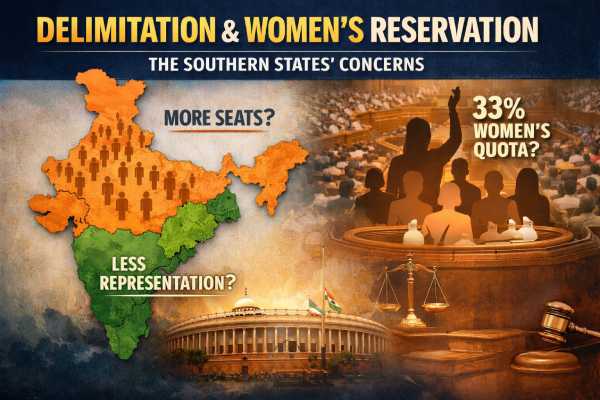
Delimitation means redrawing parliamentary seats based on population. This process has been paused for many years to protect states that controlled their population well. After 2026, this process may restart. If seats are given only based on population, states with higher population growth will get more MPs.
The Women’s Reservation Bill aims to give 33 percent seats to women in Parliament and state assemblies. Most parties support this idea. But there is one condition. It will be implemented only after delimitation. This is where the issue begins.
Southern states like Tamil Nadu, Kerala, Karnataka, Andhra Pradesh and Telangana are not against women’s reservation. They are asking for fairness in delimitation. These states controlled their population over the years. They also perform well in education, health and economy. Because of this, their population growth is slower.
If seats are decided only by population, these states may not get more representation. In simple terms, they may lose political strength compared to other regions. This is the main concern.
There is also a political angle. As explained earlier , supporting the Women’s Bill may indirectly mean supporting delimitation. Later, it becomes difficult to oppose seat changes. This creates pressure on political parties.
There is another important point. Any change in seat distribution needs a constitutional amendment. This requires strong support in Parliament. The ruling alliance alone cannot pass it. So, support from opposition parties is necessary. This gives southern states a strong voice in the discussion.
Right now, the Centre has not clearly explained how seats will be increased and shared among states. This lack of clarity is increasing concerns.
Leaders like M. K. Stalin and A. Revanth Reddy are asking for a balanced approach. They want a system that looks at more than just population. They believe factors like development and population control should also be considered. The southern states are not rejecting reforms, but they want a fair system that protects their voice in national politics.
The Southern Concern: Representation vs Population
Southern states have long been ahead in indicators such as literacy, healthcare and population control. States like Tamil Nadu, Kerala and Karnataka have maintained stable population growth for decades.
If delimitation is conducted strictly on population basis, these states risk losing parliamentary seats or seeing slower growth in representation compared to more populous regions. This creates a paradox. States that performed well on governance metrics could face reduced influence in national decision making.
This is not framed as a north versus south conflict. It is about structural fairness. The concern is whether governance success should be penalized in a representative democracy.
State-wise Impact Analysis
Andhra Pradesh
Andhra Pradesh is in a sensitive position. The state has already undergone bifurcation. Any further shift in parliamentary representation could weaken its bargaining power at the Centre. Political players like N. Chandrababu Naidu and Y. S. Jagan Mohan Reddy are aware that delimitation could redefine electoral arithmetic for the next two decades.
Telangana
Telangana has shown strong urban growth and economic expansion. Chief Minister A. Revanth Reddy has already pushed for a balanced approach. The idea of a hybrid model is gaining traction. This model attempts to combine population with development indicators to ensure fair representation.
Karnataka
Karnataka stands as a major economic engine. With Bengaluru driving national growth, the state’s concern is not just about seats but about proportional influence. A purely population-based delimitation could dilute its voice despite its economic contribution.
Kerala
Kerala presents the strongest case against population-based redistribution. It has one of the lowest fertility rates in the country. Any loss in representation would be seen as a direct penalty for effective governance.
Tamil Nadu
Tamil Nadu has emerged as the political epicentre of this debate. Chief Minister M. K. Stalin has openly warned against any move that weakens the state’s representation. Tamil Nadu’s stance is shaping the broader southern narrative.
The Centre now has to take a careful decision. It must talk to all states and find a solution that keeps the balance. This decision will shape India’s political future for many years.