
























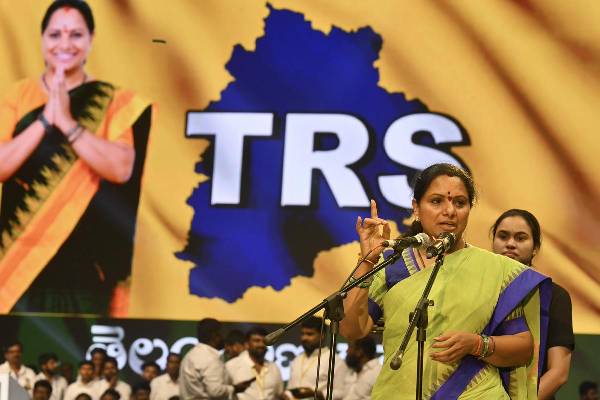
A fresh political controversy has emerged in Telangana after K. Kavitha received approval from the Election Commission of India for her new party under the name TRS. While the announcement created a buzz in political circles and media platforms, several inconsistencies have now raised serious questions about the authenticity and clarity of the entire process.
At the center of the confusion is the party’s actual name. Kavitha had earlier unveiled her political platform as Telangana Rajya Sena. However, recent communication from her PR team claims that the approved name is Telangana Rakshana Sena. The sudden shift in naming has left observers puzzled. There has been no clear explanation on when or why this change was made.
Another claim that has drawn scrutiny is the assertion that Election Commission officials personally visited Kavitha’s residence to hand over approval documents. This narrative does not align with established procedures. The Election Commission does not deliver such approvals in person. Party registration updates are typically processed and communicated through official digital channels. Physical delivery of documents to a political leader’s home is neither a known practice nor consistent with regulatory norms.
There is also the question of timing and documentation. Reports indicate that objections were raised against the use of the TRS abbreviation. Members linked to Bharat Rashtra Samithi had reportedly opposed the approval of this name. In addition, publicly available records suggest that a formal application had not even been completed at the time the party was announced. This raises further doubts about when the application was submitted, under which name, and how quickly approval was granted.
Kavitha’s own communication provides partial clarity. In a letter submitted under the banner of Telangana Jagruti, she proposed five possible names for her party. These included Telangana Praja Jagruti, Telangana Jagruti, Telangana Rakshana Sena, Telangana Rajya Jagruti, and Telangana Praja Shakti. According to her statement, the Election Commission selected Telangana Rakshana Sena, which was her third preference. She shared this update publicly and expressed satisfaction that the abbreviation TRS had been retained.
Despite this explanation, contradictions remain. The earlier public launch under a different name and the later claim of approval under another name create a gap that has not been convincingly addressed. The narrative about officials delivering documents in person only adds to the skepticism.
The political backdrop makes the issue even more sensitive. Kavitha’s move comes after a fallout with her father, K. Chandrashekar Rao, and her exit from his party, Bharat Rashtra Samithi. The original TRS name carries strong political recall in Telangana. Any attempt to reuse it is bound to trigger both legal objections and political reactions.
What should have been a straightforward party registration process has now turned into a debate over transparency and credibility. Clear communication from Kavitha’s team could resolve much of the confusion. Until then, the questions around the party name, approval process, and official claims are unlikely to fade.